
How to buy, sell, and trade One Piece cards
Explore physical One Piece card transactions and broader TCGX index trading, with their different exposure, costs, and practical steps.
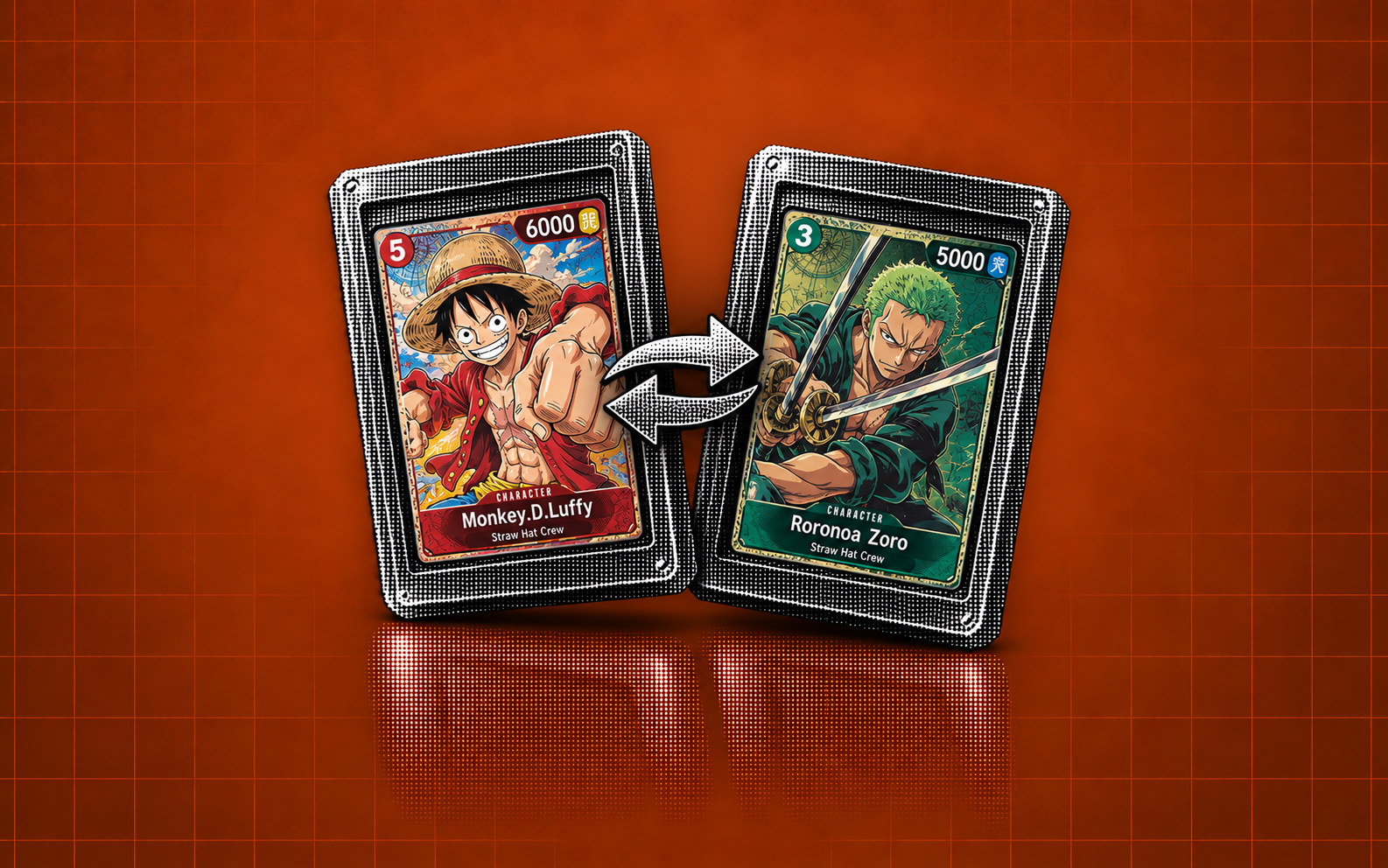
Trading One Piece cards can mean swapping physical copies, buying and reselling them, or taking financial exposure to card-market prices. Shops, marketplaces, and collector events handle physical transactions. Index trading offers a separate route for someone interested in broader price movements.
TCGX tracks selected cards across One Piece, Pokémon, Magic: The Gathering, and Disney Lorcana. A contract linked to it provides exposure to that basket, rather than ownership of a particular One Piece card. The choice depends on whether you want specific cards, a buyer for your existing cards, or a position on a broader market.
Match the route to the goal
| What you want | Route | Main consideration |
|---|---|---|
| A particular deck card or collectible | Buy or swap physical cards | Match the card number, printing, artwork, and condition |
| Proceeds from cards you already own | Sell through a shop, marketplace, or direct buyer | Compare net payment and transaction terms |
| Exposure to selected One Piece cards | Buy and later resell those items | Their prices and available buyers determine the result |
| Exposure to a broader card-market basket | Trade TCGX | Other games contribute; funding and margin apply |
An index position does not replace a physical sale. If you already own a card and want to sell it, you still need someone to buy that copy. You can also collect cards and trade an index, provided you understand the different exposure each creates.
Trading a basket instead of individual copies
Physical ownership lets you choose the exact One Piece versions you want. A player may seek an ordinary printing for a deck, while a collector may seek a particular parallel. Price exposure follows those selected items, including their condition and resale demand.
TCGX brings selected variants from several games into one index. A position linked to it responds to the broader market reference and the contract's traded price. It may rise or fall differently from One Piece cards because the basket also includes other games. The index guide explains the selection and weighting.
This changes the work and costs involved. Physical ownership involves authenticating, keeping, and eventually transferring cards; fully paid purchases have no perpetual funding or margin liquidation. Index trading does not transfer cards, but requires collateral, can incur funding, and depends on available execution prices.
How a TCGX position works
The trading instrument is a perpetual contract. A long position gains when its closing price is higher than its entry price, while a short gains when its closing price is lower, before fees and funding. The opposite move produces a loss. Buying a physical card, by contrast, gives you an item to hold or resell rather than a margined position.
The index level and the price available for a trade are separate. A quote applies to a particular side and size; an index reading does not promise an entry or exit at that level. Thin or stale pricing data and limited liquidity can lead to restrictions or a trading pause.
Funding changes the holding cost, and the account must maintain sufficient collateral. Liquidation can close a position before a later recovery. These mechanics matter even if your interest is the card market rather than short-term trading. See funding rates and liquidation.
Where to trade TCGX
The TCGX market on N1 provides this index-linked exposure. Check its current quote, funding, costs, margin requirements, and availability. The physical channels below serve a different purpose: obtaining, selling, or exchanging actual cards.
Identify the card before comparing prices
Use Bandai's official card list to check the name, card number, product, artwork, and rarity. Record the language and physical condition as well. A graded card needs its grading company and grade included in the comparison.
For example, OP01-024 identifies a Monkey.D.Luffy card. Marketplace listings distinguish versions of that card, including different artwork and product releases. The code helps narrow the search, but it does not necessarily identify every detail of the physical copy offered. Check the product and image together rather than assuming every OP01-024 listing is equivalent.
Rarity and artwork are useful identifiers, but neither tells you what a buyer will currently pay. A completed sale of another language or variant may be an unsuitable comparison even if the character and card number match.
Where to buy One Piece cards
Local game stores and retailers can offer sealed products. Marketplaces such as TCGplayer, Cardmarket, and eBay can offer individual cards and sealed products, depending on the seller and region. Check whether a listing describes a sealed pack, an opened product, a complete deck, or a single card.
Buying a single targets a particular card. Opening a booster introduces uncertainty about what you receive. Those are different collecting choices; a pictured chase card does not mean it is guaranteed in the product.
Compare the full purchase terms: card identity, condition, photos, seller record, delivery, applicable taxes, and returns. The cheapest visible listing may describe a different variant or omit costs that affect the final amount.
Where to sell One Piece cards
Common channels include online marketplaces, local shops that buy cards, and collector events. A shop may quote cash or store credit; those offers are different forms of consideration. Ask which the offer means and whether it applies to the exact copy you have.
An online asking price is evidence of what a seller wants, rather than what a buyer has agreed to pay. Comparable completed sales can provide context, but they are historical and may involve different costs or condition. Platform fees, payment rules, delivery responsibilities, and eligibility should be checked against the current terms.
Imagine an illustrative card listed for $70. An equivalent recent transaction is $55, while a shop offers $40 in cash or $50 in store credit. You cannot treat all four figures as the same price. They represent a listing, a past transaction, and two different offers. Asking price vs sold price explains that distinction.
How to arrange a physical trade
Bandai's TCG+ event guide explains how to find stores and organized events by game and location. Those can help you find a community, but you should confirm whether a venue permits trading and follow its rules.
Agree on each card's number, artwork, language, printing, and condition before discussing a swap. Use the same reference type and time period for both sides. Comparing one seller's optimistic listing with the other person's actual sale price produces an uneven comparison.
In a hypothetical swap, a parallel card with comparable sales around $60 might be exchanged for three cards around $20 each. Matching totals are only a starting point: the smaller cards may have different demand and transaction costs. Each person also has their own collecting goal.
For remote swaps, agree on the handover process and check the community's protections. A claim that a card is authentic or in a particular condition is not equivalent to independent verification. Do not assume a payment service or marketplace covers an off-platform agreement.
Sources
Keep learning
Read the N1 docs ↗
What is a trading card index? Understanding TCGX
Learn how a trading card index measures a selected basket, how TCGX works, and how index exposure differs from buying, selling, or swapping cards.
Read the guide →
How to buy, sell, and trade Pokémon cards
Compare physical Pokémon card transactions with trading TCGX index exposure, then explore how each route works and where to use it.
Read the guide →
Why do trading card prices rise and fall?
Explore how supply, demand, condition, and price evidence affect trading card markets, and why individual cards can move differently from an index.
Read the guide →